



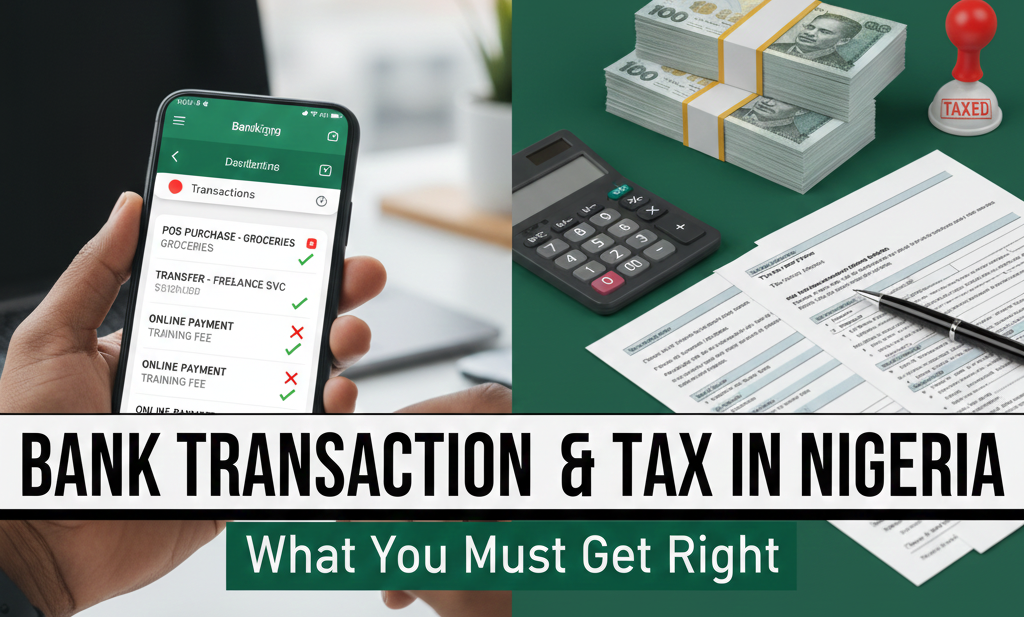
Many Nigerians unknowingly overpay tax because they misunderstand one simple thing: bank transaction description and tax in Nigeria are closely linked.
Tax authorities don’t just look at money entering your account they look at what that money is described as. If the description is wrong, it may be treated as income. If it’s accurate, you only pay tax when required.
Understanding how bank transaction descriptions affect tax, knowing what bank narration attracts tax in Nigeria, and learning how to avoid overpaying tax legally in Nigeria can save you unnecessary stress and penalties.
Tax is not about money entering your bank account.
Tax is about what that money actually represents.
If money is misdescribed, it may be treated as taxable income.
If it is correctly described, you only pay tax when legally required, nothing extra.
The key is accurate narration, not manipulation.
How Bank Transaction Descriptions Affect Tax
Here’s the truth most people don’t hear:
Tax is about classification.
This is exactly how how bank transaction descriptions affect tax works:
Incorrect narration can make non-income look like income
Income narration can trigger tax reviews
Repeated vague descriptions raise red flags
In other words, is bank transfer taxable in Nigeria? Not always — but the description determines how it’s treated.
📲 Need clarity on your transaction records? Speak with an expert
What Bank Narration Attracts Tax in Nigeria
To understand what bank narration attracts tax in Nigeria, you must separate income from non-income.
Below are legal, compliant descriptions you can use only when they are true:
Money That Is NOT Income (No Tax)
These descriptions generally do not attract tax when accurate:
Family support / Gift
When a family member sends personal money. Bank Description: Gift – Family SupportRefund / Reimbursement
When someone pays you back. Bank Description: Refund – Expense ReimbursementPersonal transfer / Savings
When moving your own funds. Bank Description: Personal Transfer – SavingsLoan received
When money is borrowed. Bank Description: Loan ReceivedCapital contribution
When you inject personal funds into your business.Bank Description: Capital Contribution
Mislabeling these can cause problems. Accuracy is part of tax compliance tips for Nigerians.
How to Avoid Overpaying Tax Legally in Nigeria
The fastest way to lose money is paying tax you don’t owe. The smartest way to save money is to understand how to avoid overpaying tax legally in Nigeria.
What smart taxpayers do:
Use correct transaction descriptions
Separate personal and business funds
Keep records that match narrations
Get professional review when unsure
This is not about hiding money. It’s about clarity and compliance.
💬 Our paid advisory helps you structure transactions the right way.
Is Bank Transfer Taxable in Nigeria?
So, is bank transfer taxable in Nigeria?
The answer depends on what the transfer represents, not the transfer itself.
Tax authorities assess:
Source of funds
Frequency
Description consistency
Supporting records
This is why understanding bank transaction description and tax in Nigeria is no longer optional, especially for business owners, freelancers, and consultants.
Final Thoughts
Tax problems often start with small mistakes — unclear descriptions, assumptions, or copied narrations. Learning how bank transaction descriptions affect tax and applying proper tax compliance tips for Nigerians protects you legally and financially.
Tax follows the nature of the transaction, not just the inflow.
Wrong description = looks like income = unnecessary tax exposure.
Correct description = correct tax treatment.
If you’re unsure whether your past or future transactions are correctly structured, professional guidance makes the difference.
📍 Office Address:
B3 Suite 13 FF, Abisco Lane, Rauf Aregbesola Shopping Complex, Ipaja Road, Lagos State
📲 WhatsApp: https://wa.me/2348063830956
📸 Instagram: https://www.instagram.com/rexobeconsult








2 Comments